Table of Contents

What happens if I refuse a DUI breath test in Washington?

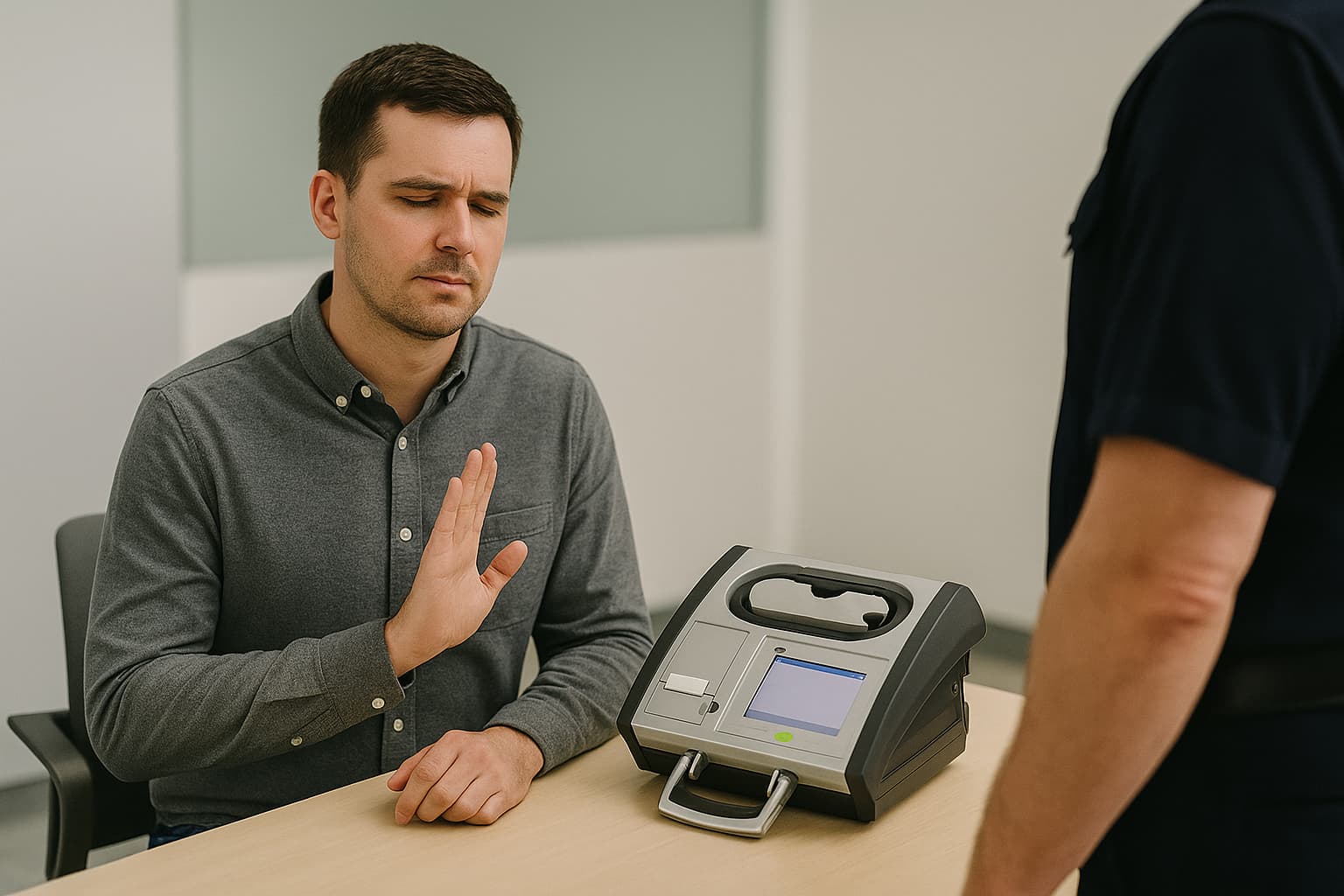
Breath Test Machine

Question: What happens if I refuse a DUI breath test in Washington?

Direct answer: Refusing an evidentiary breath test in Washington triggers an automatic license revocation of 1 year for a first refusal (and 2 years for a second within seven years) unless you request a DOL hearing within 7 days and win. If you don’t request in time, the suspension typically begins 30 days after arrest.

Key stat with citation:

The Washington Department of Licensing states you must request a DUI hearing within 7 days and pay the $375 fee (or obtain a waiver). Late requests usually waive your right to a hearing.

Expert quote with source:

“Lowering impairment on our roads saves lives, but policies also have to be clear so people know their rights.” — Summary of ongoing state safety efforts reported by Washington traffic safety leaders.

Supporting Detail:

Nationally, refusal is common. Research has reported an average refusal rate of 21% among reporting jurisdictions, which is why many states use warrants for blood draws when drivers refuse.

FAQ's:

Green Check
Is refusal a crime? No. It creates civil license penalties under implied consent; the DUI charge is a separate offense.
Green Check
How long is the revocation? Statutes authorize significant suspensions and revocations for refusals, with harsher terms for repeat incidents within seven years.
Green Check
Deadline to act?7 days from arrest to request your hearing.
TL;DR: Refusal triggers a DOL case with a 7 day deadline. Ask for the hearing, then build your defense.CTA: Need help filing today? Call now or start your intake (we file the hearing request for you).

Get a Free Consultation

CTA Arrow Icon

Key Takeaways

Green Check
Two tracks: A refusal starts a civil DOL case that can suspend or revoke your license, separate from any criminal DUI case.
Green Check
Seven days matter: You generally have 7 days to request a hearing, or you lose the right to contest the suspension.
Green Check
Revocation lengths (by statute):First refusal = 1 year; second refusal within 7 years or first with a prior admin action = 2 years (or until age 21, whichever is longer).
Green Check
Refusal does not end evidence: Officers can seek a blood warrant and still collect a sample.
Green Check
Defenses exist: Cases turn on probable cause, lawful arrest, whether warnings were clear, whether you could consult an attorney, timing, and paperwork.

Get a Free Consultation

CTA Arrow Icon
Block Placeholder Image

What Is a Breath Test Refusal in Washington?

Under Washington’s implied consent law, every driver is deemed to have given implied consent to an evidentiary breath test if lawfully arrested for DUI. A refusal occurs when a driver declines or fails to provide an adequate evidentiary sample after proper warnings are read. That refusal triggers administrative sanctions handled by the Department of Licensing, regardless of what happens to the criminal charges.

Understanding the reason

Important distinctions:

Green Check
Portable breath test vs. evidentiary test: The handheld roadside device is not the same as the evidentiary breath test at the station. The implied consent consequences attach to the evidentiary test requested after a lawful arrest.
Green Check
Civil vs. criminal: DOL action is not a criminal conviction and does not require proof beyond a reasonable doubt. The standard is administrative, the process is faster, and deadlines are strict.
Green Check
Right to a hearing: You have a right to a DOL hearing if you request it within 7 days and pay the filing fee or obtain a fee waiver.

Why It Matters

Payment Plans

Refusing the breath test does not “make the case go away.” It shifts the risk:

Green Check
License impact: State law authorizes substantial license sanctions for refusal, with harsher penalties for incidents within seven years.
Green Check
Evidence still possible: Many agencies obtain blood warrants when drivers refuse, so prosecutors may get chemical evidence anyway.
Green Check
Public safety backdrop: Washington continues to address serious traffic safety concerns, with impairment among leading crash factors in recent reporting.
Bottom line: A refusal can avoid a high BAC number in the short term, but it opens a second front at DOL that can take your license quickly unless you act.

Timeline: What Happens After a Refusal

Day 0 — Arrest and Implied Consent Warnings

After a lawful arrest for DUI or physical control, the officer reads implied consent warnings and requests an evidentiary breath sample. If you refuse, the officer issues a Notice of Intended DOL Action that explains your rights and the 7 day hearing request rule.

Days 1–7 — Your only window to request a hearing

You must submit your hearing request within 7 days of arrest. DOL charges a $375 fee unless you qualify for financial assistance. Mailed requests should be postmarked within 7 days. Late filings typically forfeit your hearing right.

Day 30 — Suspension starts if no timely request

If you do not request a hearing on time, DOL usually starts the suspension or revocation 30 days from arrest.

Scheduling and the hearing

When you request on time, DOL sets a hearing date, commonly within about 30 days of the request, excluding weekends and holidays. A hearing examiner reviews the reports and any defense evidence to decide if the law and procedures were followed.

Outcome

Green Check
Win the hearing:** No administrative suspension based on the arrest.
Green Check
Lose the hearing: DOL imposes the applicable revocation based on your history:
- First refusal: 1 year.
- Second, within 7 years or first with a prior admin action: 2 years (or until age 21, whichever is longer).
- If a test was provided and was over the limit, non‑refusal suspensions may apply on a different schedule.

Ignition Interlock License (IIL) and SR-22

If a suspension goes into effect, many drivers can apply for an Ignition Interlock License and provide SR-22 proof to drive for work and family needs during the suspension period. (Program details and eligibility are administered by DOL.)

If the police got a blood warrant

DOL can proceed based on the refusal and may also act later if a blood result is reported to the agency. Either way, do not skip the hearing request.

Get a Free Consultation

CTA Arrow Icon

How We Defend These Cases

We treat a refusal case as two connected battles: the DOL hearing and the criminal case. Our goal is to protect your ability to drive and to position your court case for the best possible outcome.

DOL Hearing Strategy

After a lawful arrest for DUI or physical control, the officer reads implied consent warnings and requests an evidentiary breath sample. If you refuse, the officer issues a Notice of Intended DOL Action that explains your rights and the 7 day hearing request rule.

Deadline triage

We file the hearing request immediately and verify receipt so you do not miss the 7 day window.

Evidence audit

We obtain the police reports, implied consent forms, any video, dispatch logs, and testing or instrument records.

Grounds to contest

  • Probable cause and lawful arrest: Did the facts justify the stop, detention length, and arrest?
  • Implied consent warnings: Were they complete and clear? Did you fully understand the consequences?
  • Access to counsel: Was your request to call a lawyer honored within a reasonable time?
  • Was it a true refusal? Ambiguous attempts, equipment issues, operator error, or medical limitations can undercut a “refusal.”

Driver plan

If risk remains, we plan for IIL + SR-22 so you can keep working and caring for your family while we fight.

Criminal Case Strategy

Refusal narrative

Prosecutors sometimes argue that refusal shows “consciousness of guilt.” We provide lawful and practical explanations (medical concerns, language barriers, machine mistrust) to neutralize that claim.

Blood warrant review

If there was a warrant, we scrutinize probable cause, scope, and sample handling.

Suppression and negotiation

We challenge the stop, the detention, the arrest decision, and any rights violations, then pursue dismissals, reductions, or outcomes that limit jail, fines, and interlock time.

Our advantage: Washington‑specific experience with implied consent law, a tight DOL hearing workflow, and fast evidence reviews calibrated to the 7 day deadline.

Get a Free Consultation

CTA Arrow Icon

Refusal vs. Provided Test: What Actually Changes?

When you’re deciding whether to blow, it helps to separate license risk from evidence risk.

If you refuse the evidentiary breath test:

Green Check
License (DOL): Immediate civil action is triggered. You must request a hearing within 7 days, or your license is suspended/revoked by default.
Green Check
Criminal case: Prosecutors may argue “consciousness of guilt.” Officers may pursue a blood warrant, so chemical evidence can still enter the case.
Green Check
Proof issues: There’s no breath number to attack for margin‑of‑error, mouth alcohol, or calibration defense often pivots to procedure, probable cause, and warnings.
Green Check
Practical reality: You protect against a potentially high BAC reading but increase the odds of a fast license hit unless you win at DOL.

If you provide the evidentiary breath test:

Green Check
License (DOL): Civil action is still possible (e.g., if your result is above the legal limit), but the grounds are different and often more number‑centric.
Green Check
Criminal case: The state gets a number to argue. Your defense can challenge machine reliability, observation periods, physiological factors, and operator compliance.
Green Check
Proof issues: You gain technical attack points (instrument logs, toxicology, mouth alcohol), but you lose the “no number” shield.
Green Check
Practical reality: You may avoid refusal‑based revocation but must be ready to litigate the breath number.
Bottom line: Refusal trades a potentially damaging BAC number for a guaranteed administrative fight. Providing trades the DOL refusal penalty for more technical attacks in court. The right call is fact‑specific; we help you weigh it quickly and act within the 7‑day window.

The 7-Day Survival Plan (Immediate Action Checklist)

Day 0–1

  • 1) Lock the deadline: Put “DOL hearing request” on your calendar for the 7th day after arrest (earlier is better).
  • 2) Call counsel now: We’ll file the request for you and confirm receipt so nothing slips.
  • 3) Write down everything: Time of stop, reason given, how long you waited, anything you ate/drank/vaped, language issues, medical conditions, and any attempts you made to comply.

Day 2-3

  • 4) Gather documents: Notice of Intended Action, any temporary license, tow/impound paperwork, citation, and discharge paperwork.
  • 5) Witness list: Anyone who saw you before the stop, at the scene, or at the station (including rideshare, bartender/manager, friends). Capture phone numbers.

Day 4–5

  • 6) Preserve video: Ask nearby businesses or residences if they have exterior cameras (they often overwrite in 7–14 days). Keep the dash‑cam or mobile video backed up.
  • 7) Work driving plan: If suspension is likely, start the Ignition Interlock License + SR‑22 conversation so there’s no gap in your ability to work or handle family obligations.

Day 6–7

  • 8) File/confirm the hearing request: Ensure the request is submitted and confirmed. Keep proof (screenshot, confirmation email, postal receipt).
  • 9) Prep for both tracks: Civil (DOL) and criminal timelines diverge—be ready to fight on both fronts.

Get a Free Consultation

CTA Arrow Icon

IIL & SR-22: What to Expect (If a Suspension Starts)

If DOL imposes a suspension or revocation, you may be able to keep driving legally by completing a few steps:

Attorney Explaining DUI Law and Process
Green Check
Eligibility check: Confirm that you qualify for an Ignition Interlock License (IIL) during the suspension period.
Green Check
SR‑22 insurance filing: Work with your insurer (or specialty carrier) to issue proof of financial responsibility (SR‑22) to the state.
Green Check
Device installation: Schedule ignition interlock installation with a state‑approved vendor; keep the receipt and compliance paperwork.
Green Check
Compliance & monitoring: Expect periodic device calibrations, data uploads, and rules about missed or failed tests.
Green Check
Reinstatement steps: When the suspension period ends, you’ll complete any remaining requirements (e.g., fees, testing, paperwork) to fully reinstate your license.
Tip: Start this planning before a suspension date so there’s no gap in your ability to commute or care for family.

Testimonial

DUI Google Reviews

Linda Callahan and her staff were compassionate, professional, and extremely knowledgeable. My DUI charge was reduced, and I felt supported every step of the way.

Star RatingStar RatingStar RatingStar RatingStar Rating
User Placeholder Image

Khai

King County
DUI Google Reviews

From my first phone call with Chris, I felt calmer. He took the time to listen, explained the process clearly, and connected me with Linda. The outcome was better than I ever expected.

Star RatingStar RatingStar RatingStar RatingStar Rating
User Placeholder Image

Jeremy

Tacoma
DUI Google Reviews

Toni and the intake team treated me with such kindness. They never judged me and made sure all my questions were answered. I can’t thank them enough.

Star RatingStar RatingStar RatingStar RatingStar Rating
User Placeholder Image

Rebecca

Olympia
DUI Google Reviews

Callahan Law is the real deal. My case was dismissed after Linda challenged the breath test results. She’s smart, strategic, and incredibly thorough.

Star RatingStar RatingStar RatingStar RatingStar Rating
User Placeholder Image

Michael

Thurston County
DUI Google Reviews

They worked with me on payments and never made me feel pressured. Communication was always fast and clear. I’d recommend them to anyone facing a DUI in Washington.

Star RatingStar RatingStar RatingStar RatingStar Rating
User Placeholder Image

Allison

Pierce County
DUI Google Reviews

I was terrified after my arrest, but Linda and her team walked me through everything. I felt like I had real advocates who cared about my future.

Star RatingStar RatingStar RatingStar RatingStar Rating
User Placeholder Image

Jared

Kitsap County
DUI Google Reviews

From my first call, I knew I was in good hands. They were understanding, knowledgeable, and fought hard for my case.

Star RatingStar RatingStar RatingStar RatingStar Rating
User Placeholder Image

Former Client

Tacoma
DUI Google Reviews

Callahan Law turned an overwhelming situation into a manageable one. Their professionalism and compassion made all the difference.

Star RatingStar RatingStar RatingStar RatingStar Rating
User Placeholder Image

Former Client

Olympia
Swipe Left Icon
Swipe Right Icon

Frequently Asked Questions

What happens if you refuse a breathalyzer in Washington?

Accordion CollapseAccordion Expand
Refusing an evidentiary breath test triggers an automatic license revocation—1 year for a first refusal, 2 years for a second within 7 years—unless you request a DOL hearing within 7 days and win. The DOL action is civil and separate from any criminal DUI case.

How long is the license suspension for refusing a breath test in Washington?

Accordion CollapseAccordion Expand
First refusal = 1 year.Second, within 7 years (or first with a prior admin action) = 2 years (or until age 21, whichever is longer), per RCW 46.20.3101.

What is the deadline to request a DOL hearing after a refusal in Washington?

Accordion CollapseAccordion Expand
7 calendar days from arrest. Mailed requests must be postmarked within 7 days. DOL charges a $375 fee unless you qualify for a waiver.

Can you refuse a breathalyzer test in Washington State?

Accordion CollapseAccordion Expand
You can refuse the evidentiary breath test, but refusal carries civil license penalties under Washington’s implied consent law and can be used in the criminal case.

Should you refuse a breathalyzer in Washington?

Accordion CollapseAccordion Expand
It depends. Refusal avoids giving a breath number but virtually guarantees an administrative fight over your license; officers may still seek a blood warrant. Talk to counsel ASAP to weigh facts and hit the 7-day deadline.

Can police get my blood if I refuse the breath test in Washington?

Accordion CollapseAccordion Expand
Often yes. Officers commonly seek a search warrant for a blood draw; DOL can proceed based on refusal and/or later blood test results.

Can you get a DUI without blowing in Washington?

Accordion CollapseAccordion Expand
Yes. Prosecutors can prove DUI with driving/impairment evidence and, if obtained, blood results, even without a breath number.

Can I keep driving for work with an ignition interlock after a refusal in Washington?

Accordion CollapseAccordion Expand
Many drivers qualify for an Ignition Interlock License (IIL) and SR-22 insurance during the revocation. We help you apply and comply with DOL rules.

Get Help Now

CTA Arrow Icon

Supporting Video

Free Case Evaluation Available

You have 7 days. We file your hearing request today, audit the reports, and build your defense.
Call 012-284-6533 or start your free case review now.

CTA Phone ShapeCTA Phone Shape